Cloudcom Systems
50HZ Inverter Drive Board Module Single 12V Boost Step Up 220V Transformer Conversion Board Bridge 150W 500W with Stabilized
50HZ Inverter Drive Board Module Single 12V Boost Step Up 220V Transformer Conversion Board Bridge 150W 500W with Stabilized
Couldn't load pickup availability
SPECIFICATIONS
50HZ Inverter Drive Board Single DC 12V AC 220V: Transformer Bridge Boost Step Up Module 500W Voltage Regulator Quasi-sine Wave
Application: Computer
Brand Name: EC Buying
Condition: New
Dissipation Power: low
High-concerned chemical: none
Operating Temperature: normal
Origin: Mainland China
Package: Module
Smart Electronics Experiment: Switch And Sensor For Arduino STM32
Supply Voltage: DC 12V AC 220V
Type: Voltage Regulator
is_customized: Yes
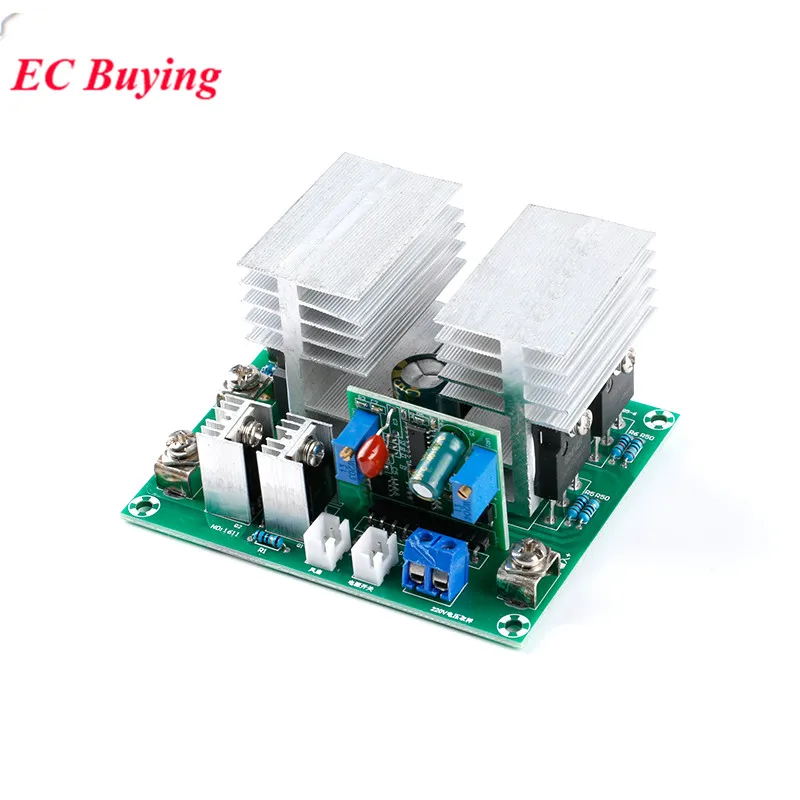
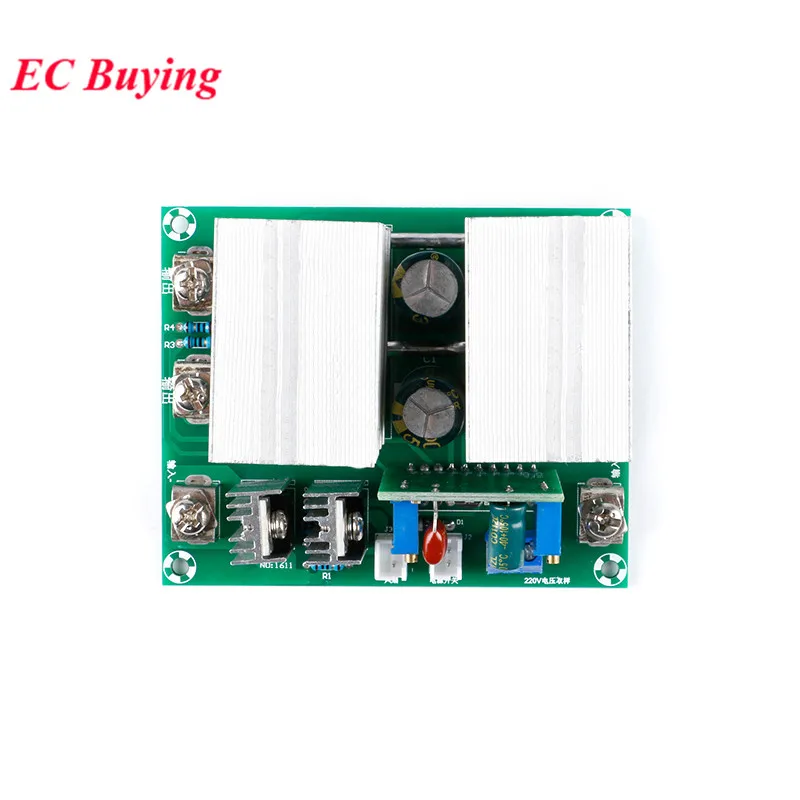
Power switch: The terminal of the power switch marked with the words "Power Switch" is used to control the work of the board, and a switch needs to be connected to control whether the board is working or not.
Input voltage: 10V-15V
Board output frequency: 50HZ
Output waveform: square wave, quasi-sine wave (decided according to the use of transformer and 220V voltage feedback, no feedback (220V voltage sampling) square wave, voltage feedback must be connected, otherwise there will be huge no-load current and serious heating problems)
Voltage feedback (220V voltage sampling): 220V voltage feedback (220V voltage sampling) must be connected
Quasi-sine wave inverter drive board
An external 50HZ 220V 8-12V transformer is required. If the voltage is greater than 10V, even if the 220V feedback voltage is connected, it may not be able to stabilize the voltage. Only one winding at the low voltage end (silicon steel sheet standard transformer)
The transformer power is suitable for less than 800W, and the maximum output power is 500W
Small transformers cannot output high power, for example, a 50W transformer cannot output 80W power
Voltage stabilization function: when the transformer is close to 12V, there is no voltage stabilization function, and it will output a square wave. The voltage stabilization function is only available for 8V-10V transformers. There is fine adjustment for customers to adjust the voltage. The voltage stabilization function needs to be connected to 220V to the board. 220V voltage sampling
With input reverse connection protection function
With undervoltage 10V undervoltage protection function
Output frequency: 50HZ, can be fine-tuned (it has been adjusted to 50hz before delivery)
The output voltage should be adjusted to about 220V before shipment. The voltage of this type of AC terminal has a slight fluctuation
No-load current: The current consumption of the board without the transformer itself is about 40mA. The size of the transformer, the silicon steel sheet material of the transformer, and the transformer voltage of 8V or 12V will all affect the no-load current after completion.
When a small fan is equipped, a capacitor can be added to the output of the transformer to correct the waveform. It can output a similar sine wave, but adding a capacitor will consume a certain amount of power and reduce the conversion efficiency. Without an inductive load, additional capacitors are not recommended
The small red and black wires on the board are connected to the power switch corresponding to the white socket marked (power switch), that is, the red and black wires are connected together and the board starts to work
The driver board is soft start, if you need a hard start, leave a message or contact customer service
note:
1. The transformer needs to use the input 220V, 50HZ, output 8V, 50HZ silicon steel sheet transformer, ring, R-shaped, E-shaped, C-shaped can be used
2. Single 8V (8V terminal has only two wires).
3. The wiring must be connected to all the wires of the transformer before powering on the test machine. Do not power on while connecting.
4. To correct the sine wave, it can be used to connect fans, televisions, light bulbs, hand drills, angle grinders and other series motors.
5. If you want to output enough power, you need to ensure the input power, small batteries, thin input lines, small transformers, and it is impossible to output high power. Recently, some customers do not understand the output power of the inverter board. The maximum output power of the transformer is 300W, but some customers think that if you just connect a 30W transformer, they want to have 100W or 300W output power. Friends with a little common sense should understand that it is impossible to output 300W power from a 30W transformer. Of course, do the reverse The change can not make the 30W transformer output more than 30W power.
6. It is strictly forbidden to use transformers with large leakage inductance, such as strip platinum transformers, transformers removed from wireless transmitters, and microwave oven transformers. High leakage inductance will produce high-energy spikes that damage the FET.
7. It is strictly forbidden to use transformers with inconsistent frequencies, such as non-50hz transformers and ferrite high-frequency transformers.
Using a transformer with a voltage higher than 10V on the low-voltage end may have a problem of low output voltage, because the output voltage depends on the input voltage and the transformation ratio of the transformer. For example, of course, when the input voltage is standard 12V (measured by a multimeter), the transformer When the standard 220V is changed to 12V, when the voltage is measured with an actual multimeter, the inverter is 220V, but many times the 220V to 12V transformers made by manufacturers are actually 220V to 12.5V or 13V. They consider the general low-voltage end of the step-down transformer Will be connected to the rectifier circuit, so it is deliberately high (the rectifier bridge has a voltage drop of about 1V, about 2 diodes), which will lead to the problem of low transformer ratio, and the voltage after inverter is lower. Using a 13V transformer, when the battery voltage drops to about 10V, the inverter voltage is about 170V, calculate 10÷13×220=169.23V, when input 12V, calculate 12÷13×220=203.076V
The no-load output voltage depends on the transformer's transformation ratio and the input battery voltage. If the no-load is normal, the severely reduced load is generally due to insufficient power of the transformer. The insufficient power here includes the following situations. The transformer itself is a low-power transformer, and For high-power multi-winding transformers, the 12V winding is selected because the transformer manufacturer makes it according to the total power distribution. For example: a 500W transformer has dual 28V windings, 9V windings, and dual 12V Winding, the manufacturer may allocate the main 400W to dual 28V windings, and the remaining 100W is allocated to 9V windings and dual 12V windings. At this time, 12V windings or 9V windings are used for inverters, which can not produce high power at all, even 100W. It may be. In addition, when the load drops, you need to consider whether the input wire is too thin or the battery is too small. Small batteries, thin wires, and small transformers can't bring out the power of the board. The transformation ratio also affects the output voltage. At this time, the most obvious manifestation is the low no-load voltage, such as a black-and-white TV that uses 220V to double 17V.
High-frequency AC output port: only suitable for resistive loads, such as ordinary household incandescent bulbs (tungsten filament bulbs), ordinary electric soldering irons, or voltage doubler rectifier circuits. Do not measure this output port when measuring the output voltage, because these voltmeters are designed The measurement of 50Hz household voltage is not the measurement of high frequency voltage, and huge measurement errors will occur.
DC output port: you can use a multimeter to measure the voltage in the DC gear, and can be equipped with switching power supply loads (appliances marked with an input voltage of AC100-240V can be used), resistive loads.
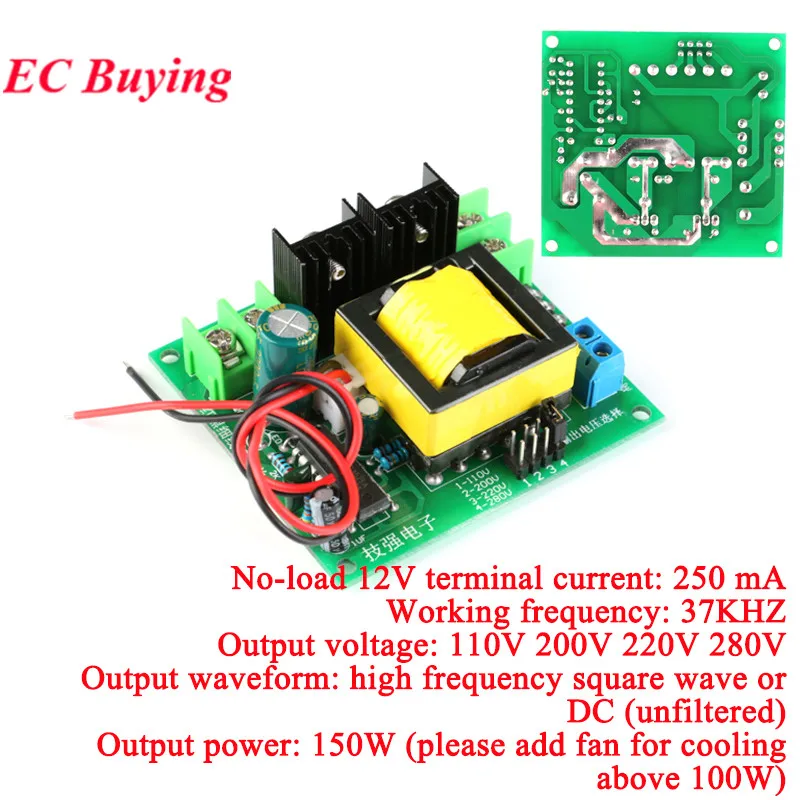
150W inverter battery DC12V step-up AC220V step-up transformer power conversion circuit board
Switch: The red and black lines on the board are switches, which are used to control the presence or absence of high voltage output
Input voltage: 12V, the lowest input voltage is 8V, the highest input voltage is 14.8V
Since there is no input fuse on this board, please add the fuse yourself, it is recommended to add a 15A fuse
(Lithium battery power supply and switching power supply, DC power supply, this kind of power supply will cause the tube to overheat and burn out), the output is not regulated, and the input must ensure sufficient power (current), otherwise it will easily burn the tube
Output voltage: 110V 200V 220V 280V
Output waveform: high frequency square wave or DC (unfiltered)
Output power: 150W (please add fan for cooling above 100W)
No-load 12V terminal current: 250 mA
Working frequency: 37KHZ
Use field effect tube: YPI7575C field effect tube
Protection: Without any protection, please add the fuse yourself
Features: No soldering, input terminals use 7.62 terminals, high frequency AC output uses blue 301 terminals, DC output 7.62 terminals (directly loosen the top screw of the terminal, insert the wire, and tighten the screw)
The voltage can be selected arbitrarily, through the jumper cap, no welding is required
The output power is large, if there is a fan for heat dissipation, the board can output 200W power
Adopt double-sided circuit board.
AC output: can be connected to voltage doubler rectifier, or pure resistive load
Available electrical appliances range: 1. Switching power supply loads, generally electrical appliances marked with an input voltage of 100-240V can generally be used, such as non-cottage mobile phone chargers, set-top boxes, DVDs, LED lights (with constant current drive, so some can be used Some LED lamps cannot be used, they can only be connected to the DC output port when in use, and must not be connected to the high-frequency AC output port), ordinary tungsten bulbs, small hand drills, energy-saving lamps, ordinary electric soldering irons without temperature adjustment, and high voltage is required The voltage doubler rectifier circuit, the LCD TV is connected to the DC output port and so on.
Unavailable electrical appliances range: iron-core transformers, such as audio with iron-core transformers, temperature-regulating electric soldering irons, dimming lamps, and AC motor loads such as electric fans. Cheap RC step-down LED lamps (such as LED night lights, straw hat LED lamps, plastic LED lamps)